Leading provider of Thermal Conductivity Testing and Thermal

Conductivity Instruments as well as Thermal Resistivity,

Specific Heat Capacity and Thermal Diffusivity.
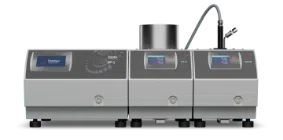
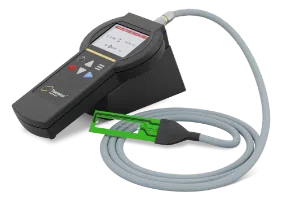
The Hot Disk Tranisent Plane Source (TPS), often referred to as "The Gustafsson Probe" in honor of its inventor is designed to non-destructively measure the thermal conductivity, thermal difusivity and specific-heat capacity of solid, liquid, paste and powder materials in the range of 0.005 W/mK to 500 W/mK over temperatures ranging from 30 K to 1000 K.
Principles
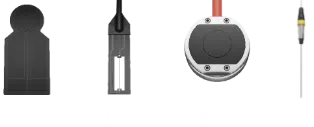
Based on the theory of the Hot Disk Transient Plane Source technique, the TPS Thermal Conductivity Analyzer utilizes a sensor element in the shape of a double spiral. This TPS sensor acts both as a heat source for increasing the temperature of the sample and a ”resistance thermometer” for recording the time dependent temperature increase. In most cases the sensor element is made of a 10 μm thick Nickel-metal double spiral, with precisely designed dimensions (width, number of windings and their radii). This spiral is supported by a material to protect its particular shape, give it mechanical strength and keep it electrically insulated. The polyimide ”Kapton” is such a material, which can be used throughout the temperature range from 10 K to 500 K. A ”Mica” material is also available as supporting / insulating material and in that case the upper limit of the temperature range is extended to

1000 K.
The encapsulated Ni-spiral sensor is then sandwiched between two halves of the sample (solid samples), or embedded in the sample (powders, liquids). During a pre-set time, 200 resistance recordings are taken, and from these the relation between temperature and time is established. A few parameters, like the "Output of Power" to increase the temperature of the spiral, the "Measuring Time" for recording 200 point and the size of the sensor are used to optimize the settings for the experiment so that thermal conductivities from 0.005 W/mK to 500W/mK can be measured.
Next Page